The company behind the breakthough, Carbios, has partnered with major companies including Pepsi and L’Oréal. Photograph: Mario Anzuoni/Reuters
A mutant bacterial enzyme that breaks down plastic bottles for recycling in hours has been created by scientists.
The enzyme, originally discovered in a compost heap of leaves, reduced the bottles to chemical building blocks that were then used to make high-quality new bottles. Existing recycling technologies usually produce plastic only good enough for clothing and carpets.
The company behind the breakthrough, Carbios, said it was aiming for industrial-scale recycling within five years. It has partnered with major companies including Pepsi and L’Oréal to accelerate development. Independent experts called the new enzyme a major advance.
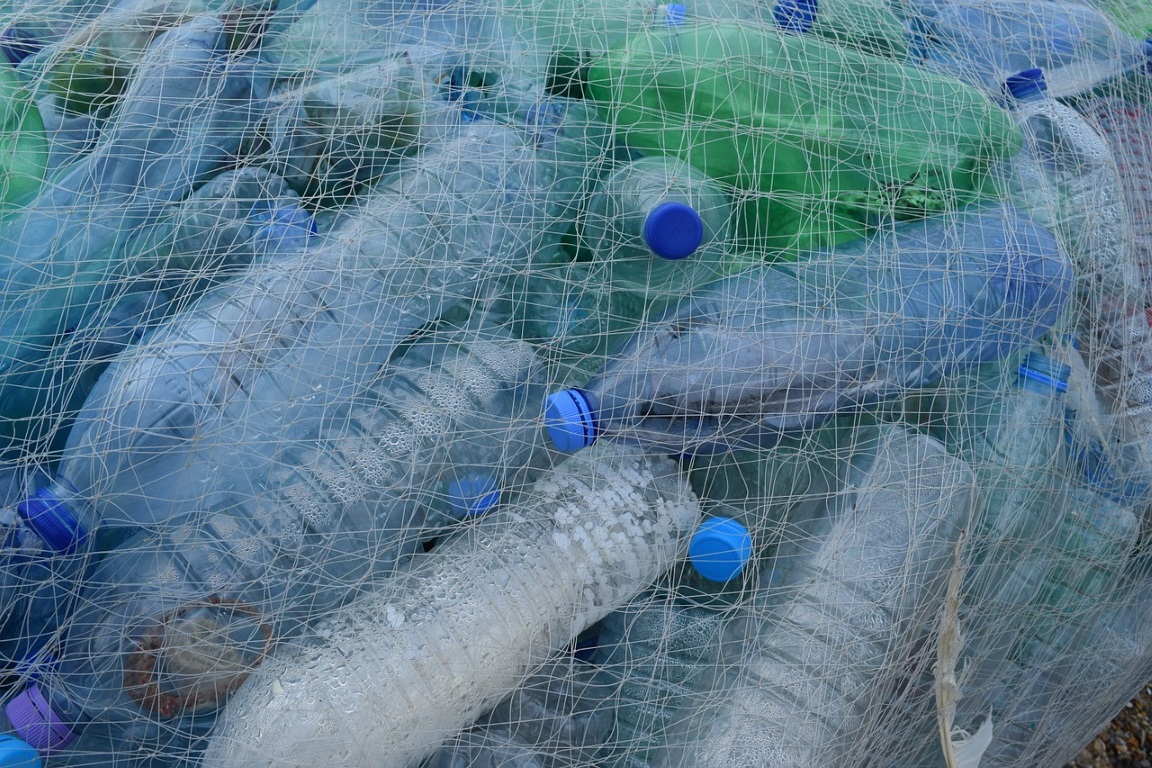
Billions of tonnes of plastic waste have polluted the planet, from the Arctic to the deepest ocean trench, and pose a particular risk to sea life. Campaigners say reducing the use of plastic is key, but the company said the strong, lightweight material was very useful and that true recycling was part of the solution.
The new enzyme was revealed in research published on Wednesday in the journal Nature. The work began with the screening of 100,000 micro-organisms for promising candidates, including the leaf compost bug, which was first discovered in 2012.
“It had been completely forgotten, but it turned out to be the best,” said Prof Alain Marty at the Université de Toulouse, France, the chief science officer at Carbios.
The scientists analysed the enzyme and introduced mutations to improve its ability to break down the PET plastic from which drinks bottles are made. They also made it stable at 72C, close to the perfect temperature for fast degradation.
The team used the optimised enzyme to break down a tonne of waste plastic bottles, which were 90% degraded within 10 hours. The scientists then used the material to create new food-grade plastic bottles.
Carbios has a deal with the biotechnology company Novozymes to produce the new enzyme at scale using fungi. It said the cost of the enzyme was just 4% of the cost of virgin plastic made from oil.
Waste bottles also have to be ground up and heated before the enzyme is added, so the recycled PET will be more expensive than virgin plastic. But Martin Stephan, the deputy chief executive at Carbios, said existing lower-quality recycled plastic sells at a premium due to a shortage of supply.
“We are the first company to bring this technology on the market,” said Stephan. “Our goal is to be up and running by 2024, 2025, at large industrial scale.”
He said a reduction in plastic use was one part of solving the waste problem. “But we all know that plastic brings a lot of value to society, in food, medical care, transportation. The problem is plastic waste.” Increasing the collection of plastic waste was key, Stephan said, with about half of all plastic ending up in the environment or in landfill.
Another team of scientists revealed in 2018 that they had accidentally created an enzyme that breaks down plastic drinks bottles. One of the team behind this advance, Prof John McGeehan, the director of the Centre for Enzyme Innovation at the University of Portsmouth, said Carbios was the leading company engineering enzymes to break down PET at large scale and that the new work was a major advance.
“It makes the possibility of true industrial-scale biological recycling of PET a possibility. This is a very large advance in terms of speed, efficiency and heat tolerance,” McGeehan said. “It represents a significant step forward for true circular recycling of PET and has the potential to reduce our reliance on oil, cut carbon emissions and energy use, and incentivise the collection and recycling of waste plastic.”
Scientists are also making progress in finding biological ways to break down other major types of plastic. In March, German researchers revealed a bug that feasts on toxic polyurethane, while earlier work has shown that wax moth larvae – usually bred as fish bait – can eat up polythene bags.
Brasil é o quarto país que mais produz lixo plástico no mundo
Por Sabrina Rodrigues
quarta-feira, 06 março 2019 19:31
2 Comentários
O Brasil produz 11 milhões de toneladas de lixo plástico no mundo. Foto: Pixabay.
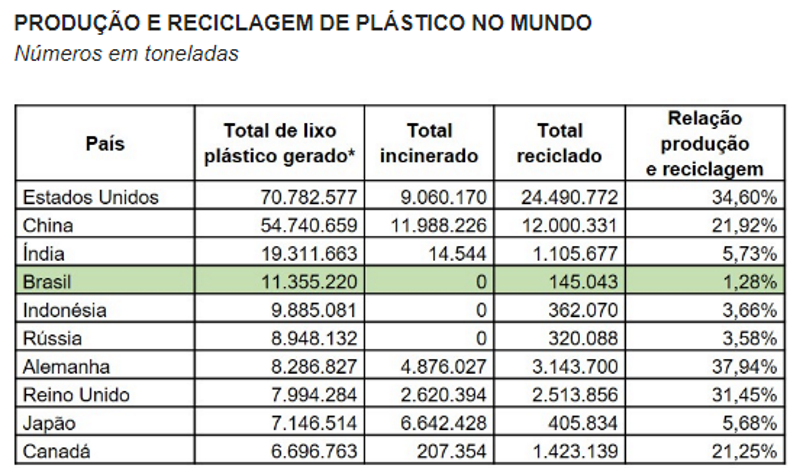
O Brasil é o quarto maior produtor de lixo plástico no mundo com 11 milhões de toneladas, ao ano, ficando atrás apenas dos Estados Unidos, China e Índia. E desse total, apenas noventa e um por cento, ou seja, mais de 10 milhões de toneladas foram coletadas. Esse é o alerta do estudo Solucionar a Poluição Plástica: Transparência e Responsabilização do WWF. A ONG compilou dados do Banco Mundial, que analisou a produção de plástico em mais de 200 países.
O levantamento afirma ainda que o Brasil produz, em média, aproximadamente 1 quilo de lixo plástico por habitante a cada semana e que recicla muito pouco. Somente 145 mil toneladas do lixo plástico gerado é reaproveitado, um índice de 1,28%, um dos menores da pesquisa que aponta que a média global de reciclagem é de 9%.
As falhas no tratamento e coleta de lixo plástico vão desde perdas na separação de tipos de plásticos até o baixo valor pago na reciclagem. Ainda segundo o estudo, 7,7 milhões de toneladas desse material plástico vão parar nos aterros sanitários e outros 2,4 milhões de toneladas são descartadas de forma irregular, sem tratamento, em lixões a céu aberto.
“É hora de mudar a maneira como enxergamos o problema: há um vazamento enorme de plástico que polui a natureza e ameaça a vida. O próximo passo para que haja soluções concretas é trabalharmos juntos por meio de marcos legais que convoquem à ação os responsáveis pelo lixo gerado. Só assim haverá mudanças urgentes na cadeia de produção de tudo o que consumimos”, afirma Maurício Voivodic, Diretor Executivo do WWF-Brasil.
Fonte: WWF / Banco Mundial (What a Waste 2.0: A Global Snapshot of Solid Waste Management to 2050) * Valor total de lixo plástico descartado em resíduos sólidos urbanos, resíduos industriais, resíduos de construção, lixo eletrônico e resíduos agrícolas, na fabricação de produtos durante um ano.
Acordo internacional
Ainda segundo o estudo, desde 2000 o mundo já produziu a mesma quantidade de plástico que em todos os anos anteriores somados. Sem reciclagem, estima-se que um terço de todo o plástico descartado tenha se inserido na natureza como poluição terrestre, de água doce ou marinha. Se nada for feito, a quantidade de poluição plástica dobrará no planeta até 2030, sendo os oceanos os mais afetados.
“Baseada nos resultados desta pesquisa, o WWF pede que governos, indústrias e o público reconheçam com urgência que a abordagem mundial atual para a crise dos plásticos não está funcionando. A ausência de uma resposta sistemática eficaz, seja em nível nacional ou internacional, impede o progresso, ameaça o crescimento econômico sustentável, e tem consequências diretas para o meio ambiente, espécies e pessoas”, propõe a ONG.
Early Tests Show a New Technique Could Turn 25% of Our Plastic Waste Into Fuel
MIKE MCRAE
14 FEB 2019
Reduce. Reuse. Recycle. It's not enough. When it comes to the crisis of mounting plastic waste, we're still coming up short on ways to plug the flow.
Soon, we might be able to add 'rewind' to that list - thanks to a new technique for turning the polypropylene that makes up a proportion of plastic waste back into liquid hydrocarbons. It might not be the ultimate solution, but making fuel from waste would provide a new economic incentive to clean up our act.
Chemists from Purdue University in the US have come up with a clever way to liquefy the polymers that make up roughly a quarter (25 percent) of all plastic waste and turn the results into a diesel-like product suitable as a blendstock for fuel.
"Our conversion technology has the potential to boost the profits of the recycling industry and shrink the world's plastic waste stock," says chemical engineer Linda Wang.
Their technique relies on a strange quirk of water - when squeezed and heated at the same time, it can behave as if it's at once a liquid and a gas. This 'supercritical' phase is achieved by cranking its temperature to somewhere just under 500 degrees Celsius (930 Fahrenheit) for a few hours, while applying around 23 megapascals (just over 225 atmospheres) of pressure.
In this form, the water can act as a mix of solvent and catalyst for rejigging the molecular make-up of the plastic's polymers, converting plastic into a fluid of medium length hydrocarbon chains called naphtha with the help of donated hydrogen atoms.
The process – called hydrothermal liquefaction – has been used for a variety of other processes, including the upgrading of heavy crude oil and removing contaminants from oil.
It's been applied to polyethylene before, but the results have been underwhelming and inadequately described, prompting Wang and her team to have another crack at it.
They were able to convert more than 90 percent of the model polypropylene's mass into products such as fuel-grade naphtha, with follow-up analyses suggesting the process was potentially more energy efficient and environmentally friendly than burning or even recycling waste.
Turning old chip packets back into fossil fuel might not fill every environmentalist's heart with joy, but our lust for cheap liquid petroleum could put a price on unwanted plastic materials that would otherwise find their way into the environment.
"Our strategy is to create a driving force for recycling by converting polyolefin waste into a wide range of valuable products, including polymers, naphtha (a mixture of hydrocarbons), or clean fuels," says Wang.
"Plastic waste disposal, whether recycled or thrown away, does not mean the end of the story," says Wang.
"These plastics degrade slowly and release toxic microplastics and chemicals into the land and the water. This is a catastrophe, because once these pollutants are in the oceans, they are impossible to retrieve completely."
Converting the plastic into an economically alluring product that doesn't pose the same kind of environmental harm could help pour money into the recycling business, while ending up as CO2rather than a turtle-choking hazard.
That might sound like we'd be just exchanging one global threat for another, but in the form of landfill our plastic waste already contributes a proportion of greenhouse gas pollutants to the atmosphere.
As a concentrated source of fuel, there might even be hope of managing and capturing those emissions, and perhaps even turn them back into plastics again.
The ultimate solution would be to shake our addiction to plastics altogether, by refusing or reusing, or perhaps replacing products with economically viable alternatives.
In the meantime, we're still left with one enormous problem to solve, one that continues to growdecade by decade.
Rewinding plastic back into oil might not be a perfect answer. But it just might give us the ticket we need to put us on the road to a better solution.